Posted on

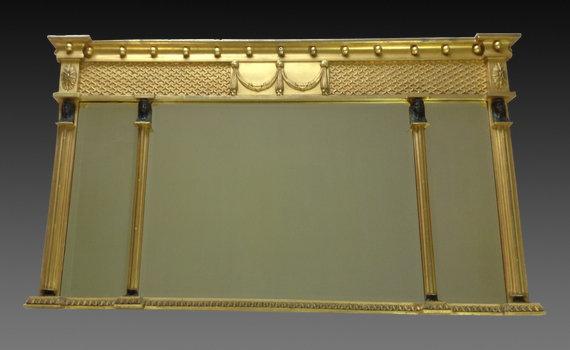
Giltwood and Gesso Overmantel Mirror.

A Victorian giltwood & gesso overmantel mirror of Egyptian inspiration. The original triple plates with bevelled edges, inset gilt frame flanked by closed cluster columns with ebonised Pharaoh busts and feet. The moulded cornice with cannon ball decoration, above a lattice work frieze panel with swags. Gilding refreshed.

Height 32″

Cornice width 56.5″

Base width 55.5″

Depth 3″

English

Circa 1860

Posted on

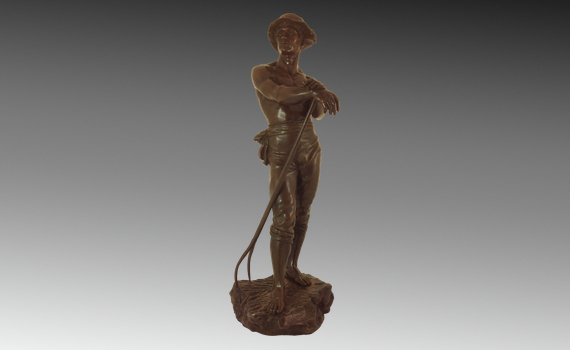
Charles Levy Bronze ‘Faneur’

Charles Levy (1820-1899)

‘Faneur’

A late 19th century, French,  patinated figure of a haymaker standing on a naturalistic base of flattened corn, his arms folded resting on a pitch fork and with water bottle tied to his waist. Original dark brown patination. Numbered 2750 above a Bronze Garanti Seal to rear.

French

Circa 1890

Posted on

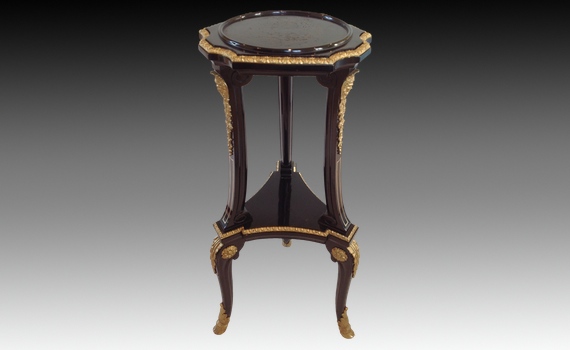
Robert Blake Ebonised & Gilt Stand

Blake

A mid 19th century ebonised and gilt bronze mounted stand in the Louis XIV style. The shaped top with circular moulded rim, above three shaped supports with brass line inlay united by a platform stretcher. The well cast and chased mounts when removed are each incised to the reverse ‘Blake’. The three sabots each incised visibly when inverted.

English

Circa 1840

Although little is known of the Blake Family, they are listed at 8 Stephen Street, off Tottenham Court Road, between 1826 and 1881. Robert Blake is listed as a cabinet inlayer and buhl manufacturer between 1826 and 1839. A Charles Blake was born to Robert and Anne on 17th March, 1814 in Holborn ‘lying in hospital’. Another son Henry was christened in 1821. From 1842 they are listed in Kelly’s as ‘Blake, Geo. & Bros…’ and from 1847 as ‘Blake, Charles, James & Henry….’. As well as manufacturers they are also listed as ‘buhl cutters’ from 1847 onwards and there are no references at this date to the Blakes as cabinet makers. In 1845 Geo. Blake & Bros. are listed at Stephen Street as ‘cabinet inlayers’ and in the same year the firm of Geo. Blake & Co. are listed at 130 Mount Street, Berkeley Square. They opened up new premises in the heart of Mayfair as well as keeping on the workshops of the Tottenham Court Road. It seems most likely that the Mount Street address was established as a showroom or retail premises rather than a work shop.

The only specimens of boulle work furniture by Blake so far identified are a pair of free standing commodes in the Frick collection, and a companion pair sold by Sotheby’s, 2 Nov 1990, lot 231, and a fifth example sold on 29 Oct 1993, lot 71. All have the same ‘Blake’ incised to the reverse of various mounts. See Robert Blake, page 112/113, Pictorial Dictionary of marked London Furniture 1700-1840.

 There is a magnificent piano at the Metropolitan Museum, New York by G.H. Blake, and a circular table at Alnwick Castle, the seat of the Duke of Northumberland. An associate group of eight tables based on a design by Richard Bridgens in ‘Design from Furniture and Candelabra’, 1838 were made by E.H. Baldock with marquetry attributed to Henry Blake. It must be assumed that many of these makers and dealers knew each other and were constantly calling in on each other’s premises to see what was being made. The great late nineteenth century commentator F. Litchfield, after a paragraph on John Webb in the Illustrated History of Furniture, writes The name of Blake too, is one that will be remembered by some of our older readers who were interested in marqueterie furniture of forty years ago; an inlaid centre table which he made for the Duke of Northumberland, from a design by Mr. C.P. Slocombe, is now in Syon House; he also made excellent copies of Louis XIV furniture.

Posted on

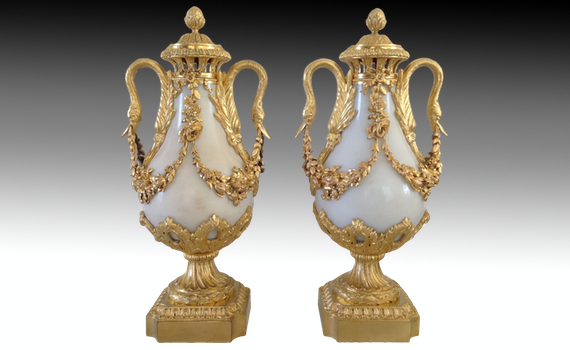
Pair of Ormolu & Marble Urns and Covers of Louis XVI Style

A pair of Napoleon III carrera marble and gilt bronze mounted urns and covers. The removable lids with pinatum finials, above pierced necks with a turned marble body mounted with handles formed as swans heads issuing from bullrushes, hung with garlands of flowers and supported by swept socle with stepped square base. Stamped ‘J C’ to underside, for J. Charpentier. Original gilding to mounts. Left side to bow missing on one urn, see image.

Circa 1880

French

Posted on

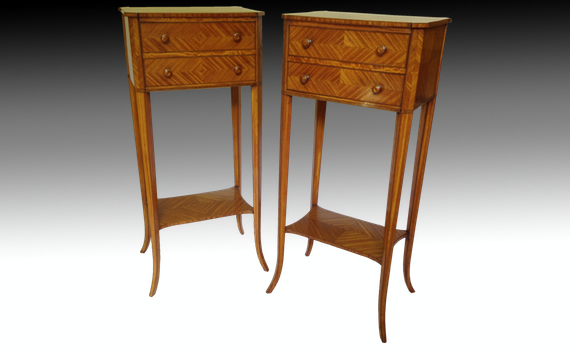
Pair of Edwardian Satinwood Tables

A small pair of Edwardian, satinwood and kingwood crossbanded, side tables. The quarter veneered rectangular tops with outset corners, above two slim oak lined drawers with unusual inlaid turned pulls, and standing on four slender tapering square legs united by a platform stretcher and ending in splay feet.

Circa 1900

English

Posted on

French Gilt Bronze Urns

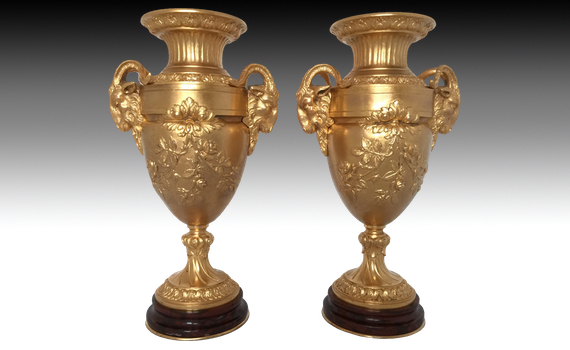
A pair of Napoleon III gilt bronze urns. Each with ovoid body and flared rim, cast with a floral spray of roses to the front and reverse, flanked by rams head masks and supported by a flared scow with rouge Grotto marble bases. Stamped 874 to the bases, the handles stamped E.G.

Posted on

Satinwood Column

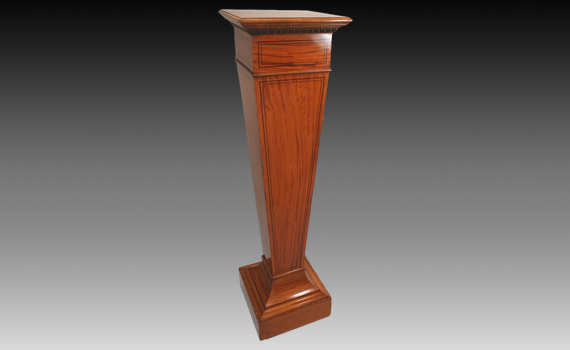
A late 19th century, Satinwood, ebony line inlaid and tulipwood crossbanded torchère. The square top with crossbanded border and moulded edge, above a tapering line inlaid column, standing on a concave moulded stepped base and plinth. Inlaid on all four sides.

English

Circa 1890

Posted on

Bronze Mercury & Ceres

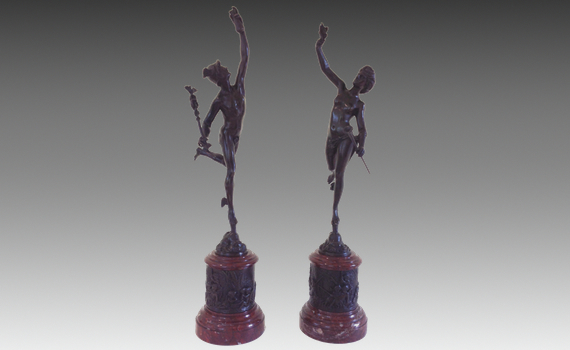
A pair of late 19th century, French, patinated bronze figures of Mercury & Ceres after Giambologna, probably by Barbedienne. The figure of Mercury holding a caduceus, Ceres with a trumpet in her hand, both standing on  blowing wind, Zephyr, supported by a rouge marble plinth with central bronze frieze cast with frolicking Putti. Original dark patination.

French

Circa 1880

Posted on

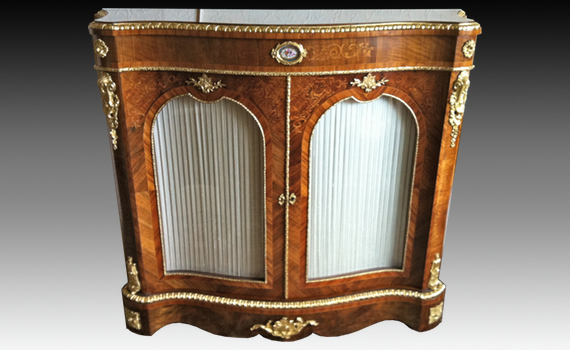
Walnut Side Cabinet

A mid Victorian walnut, tulipwood crossbanded and ormolu mounted side cabinet. The finely figured serpentine fronted top above a frieze with central oval porcelain plaque, with a pair of shaped glazed doors below, pleated with silk, enclosing a relined interior, and standing on a plinth base. The whole with well cast and chased gilt metal mounts.

Circa 1870

English

Posted on

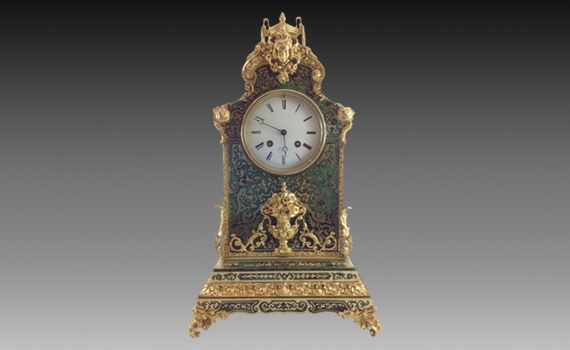
Green Boulle Clock

Miroy Fres A Paris

A Napoleon III green tortoiseshell, cut brass and ormolu mounted, Boulle, mantel clock. The shaped oak carcase decorated to front and sides with scrolling brass marquetry, standing on a stepped plinth base with acanthus scroll feet, the sides with pierced panels backed in red silk. The eight day Vincenti movement numbered 912, with Brocot suspension and outside countwheel striking the hour & half hour on a bell.

French

Circa 1870

Posted on

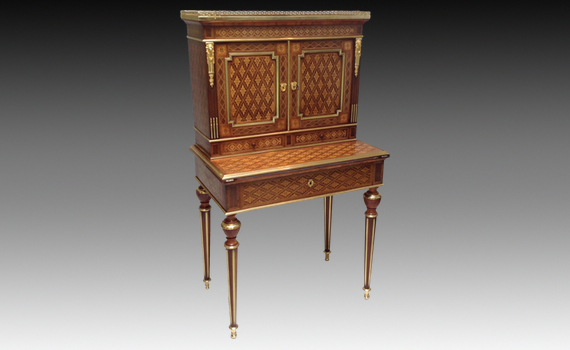
French Parquetry & Marquetry Bonheur Du Jour

A Napoleon III, French, stained maple, purpleheart and boxwood marquetry & parquetry bonheur du jour. The rectangular top with pierced metal gallery, above a pair of panelled doors enclosing a rosewood interior, with two small drawers under. The base with a fold over writing flap and single frieze drawer, standing on four turned, brass fluted tapering legs ending in gilt metal sabots. The mounts regilded.

French

Circa 1870

Posted on

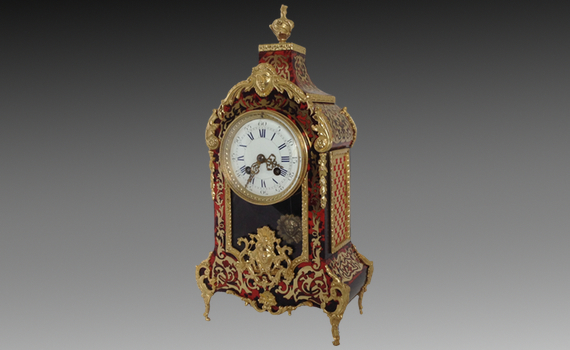
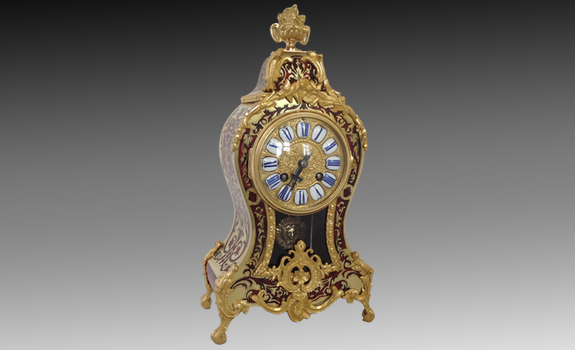
Red Tortoiseshell and Brass Inlaid Boulle Clock

A late 19th century, French, scarlet red tortoiseshell and brass inlaid mantel clock with rococo gilt bronze mounts. The shaped case with straight sides, mounted with pierced metal & material lined panels, surmounted by a flame finial with a glazed front panel and visible starburst pendulum. The circular enamel dial with blue roman numerals and pierced brass hands, with an eight day Japy Freres movement and Brocot suspension, rack striking the hour and half hour on a bell. Mounts regilded. Movement numbered 8145.

French

Circa 1890

Posted on

Scarlet Red Tortoiseshell and Brass Boulle Clock

Charles Hour Paris

A late 19th century, French, brass inlaid scarlet red tortoiseshell and ormolu mounted mantel clock. The finial modelled as a basket of fruit above a waisted shaped case inset with glazed panel and visible starburst pendulum, the sides and front inlaid  with engraved scrolling brass and mounted with rococo gilt bronze. The circular twelve piece enamel dial, with an eight day movement and brocot suspension, striking the hour and half hour with outside countwheel on a bell. Movement and pendulum numbered 4363.

French

Circa 1880